Showing posts with label Planets. Show all posts

Saturday, March 7

Confused? So am I.


     So, today we learn the difference between a Plutoid and a Dwarf Planet. Shown here is a Dwarf Planet, named Ceres. NASA now has a spacecraft orbiting this unexplored new world, also known as a Kepler Object. Dwarf Planets are; as you would imagine small planets. Now, to my knowledge there is only one Plutoid in our solar system. Just a few years back, and all through my school days it was known as Pluto. Planet #9 of 9 planets orbiting Sol, the star that the planets in the "Solar" System orbit about. 

Now to see a "Plutoid" click here  . So "the ones who or whom know all about this" decided that since everyone in my generation, and a few generations before learned Pluto was a planet, with a few odd differences. These differences (orbital path, size and other) set Pluto apart and can't be called a planet nor can it be called a Dwarf Planet. So Pluto goes beyond "planet" and becomes the sole resident of a new "planetary" body. 

Saturday, June 18

giants

History, strange to refer planetary science as history, but the highest resolution photos of Neptune were taken by the Voyager twins back in the 70's. The two space craft Voyager 1 and 2 are now nearing the edge of the solar system. Talk about enlightening... things behave quite different beyond the touch of  Sol. At the edge of the solar system, solar wind is all but nonexistant, heat from our sun is negligible, the only thing that remains constant would be space... empty and cold. Do a google on Voyager, I'm sure you will be filled in on the heliodrome, or what ever the band in space at the edge of the  solar system is called, which we would know nothing of if not for Voyager 1 and 2. Star Trek did an episode featuring Voyager, as the alien vessel would keep making mention to "veeger" Spock figured that one out, go figure huh?
       One thing just occurred to me, seems all the Gas/Ice Giants have turbulent "big spots" weather systems on them, Jupiter has its big red spot, Saturn has a great Yellow and here on Neptune you see the great blue spot. Just an observance.
      Also noticed, Mercury, Venus, Earth, and Mars, the "solid" planets are inside the asteroid belt, once past that, the only solid forms are moons, all "planets" would be gas/ice giants. Something to do with solar wind, and/or heat... too obvious to over look. 
      Signing off, your roving space reporter, Neo... good day all.

Friday, June 18

Yea I still think this way

This is exactly what I am talking about. I can hardly see this boulder being called a 'moon'. This 'space debris' is one of Saturn's moons named Helene. 


As I sit here I think I could be on to something of vast importance here; my next letter to NASA:


To whom it may concern, 


In the wake of not only changing the classification of, but also using it as a classification; Pluto now being known as a 'Plutiod. I feel the definition of "a moon" needs reclassified and a new satellite classification is in order. I would like the non-spherical objects now known as moons to be redefined as "space debris". When one talks to me of moons, in my minds eye I see a sphere, glowing in the night sky. 
scientifically speaking, 
                                                                                   Pirate Named Neo


      This does go all the way back to my primary school days when I would open my science text book and see a picture of Phobos and Deimos the moon of Mars. I would think, "how can they have an entire belt of Asteroids, not so far away from Mars, and still you are going to call these 2 chunks of space stuff moons? And then check this my scientific friend, the orbit of Phobos is in a state of decay. Meaning that at some point you will need to change Phobos from a moon to a meteor.

Friday, January 29

The New World

I think you, my regular reader, are starting to get the point that I have an interest in space and space exploration. I use my email as a sort of 'portal' to the different posts available on the different NASA missions. The latest of which is the Messenger Probe. I came across this one, with lots of pics of the 'unseen' side of the planet closest to the sun. 


I have grown up in the beginning stages of the "Space Age" I do think man will step foot on other worlds besides Luna, the earths closest neighboring world. I think the next step is to go to Mars, may not happen in my life time but we will get there some day. I think space exploration is the bridge to world peace. In my day, it was USA vs Russia (USSR) and to an end, came together with shared access to the worlds first space station known as Skylab. The Cassini/Hugens mission is a step in the right direction, the USA working with the European Space Agency to "foot the bill" on what has been thus far a great mission of discovery and exploration. If you really think about it, doen't a world of Allies beat Allies vs ? 


Through history war has been the forefront of technology and advance. Brought us through the stone age into the iron age, to the bronze age and evenually the Nuclear age. Allience is after all based on a common effort or cause. 


Quoting a musical great, Come Together. This time in the name of science, technology and advancement.


Bookmark and Share

Tuesday, January 26

OMG more Space Stuff


I have posted on Mutual Event before. Came across this series of images taken by the Cassini probe. The 3 images where taken in about a one minute span. Dione passing in front of Tethis, from about 1.6 million miles away. Dione is about 1.4 million miles away. I read scientists study this to better understand the moons of Saturn, and their behavior, or something like that. I say its just cause they're curious and Earth having only the one moon this sort of thing is interesting.

One of the most interesting things to me is how a moon becomes a moon, and orbits its parent planet. Wouldn't you think if its just space debris caught into orbit wouldn't it just crash into the planet like a meteor? How does a moon maintain orbit speed? For that matter, why don't the planets crash into the sun? It is some pretty complicated rocket science to get a man made satellite into orbit around a planet. Gravity assist fly-bys, rocket adjustments, and thrusters all fire at a given time. Just boggles my mind. 


One thing that was never really covered in school is 'where' does gravity originate? Even asteroids have gravity. Everything in space generates gravity, including space ships and man made satellites. At least that's the info I have come across in my reading. For example:


in theory-
if an asteroid or other Near Earth Object (NEO) is on trajectory to impact the Earth, a solution could be to send a space craft to travel along a near same trajectory, using that crafts gravitation to pull the NEO off present trajectory and miss the Earth. At the proper distance the path would only need a few degrees of change to prevent a collision. 


I also find it interesting that a Near Earth Object is called Neo... blink blink.


Bookmark and Share

Friday, June 5

Titan


Bookmark and Share

Thursday, June 4

another planet


Bookmark and Sharedo you know the solar system?

Venus

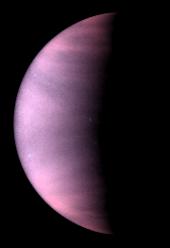
Venus is beautiful, called Earth's "twin" planet is as different as twins
can be. Very hot and very dry, so hot any liquid would simply boil away. More facts with numbers and more pics here. Look up at night, in the western sky; the bright one is Venus.

The temperature of the uppermost layer of Venus's clouds averages about 55 degrees F (13 degrees C). However, the temperature of the planet's surface is about 870 degrees F (465 degrees C), higher than that of any other planet and hotter than most ovens.


Bookmark and Share